What Is a ROSCA? The Complete Guide to Rotating Savings Circles
A ROSCA (Rotating Savings and Credit Association) is one of the oldest and most widespread financial systems in the world. It's simple: a group of people contributes a fixed amount on a regular schedule, and each round one member takes home the entire pot. No bank. No interest. No credit check. Just community trust turning small contributions into meaningful lump sums.
If you've heard the words DuKuti, Dhukuti, tanda, susu, chit fund, kye, hui, stokvel, or paluwagan, you already know what a ROSCA is — you just know it by a different name. Across cultures and continents, communities have relied on this model for centuries to fund businesses, pay for weddings, cover emergencies, and build wealth without the barriers that come with traditional banking.
This guide covers everything: how a ROSCA works step by step, the math behind it, the benefits and risks, how it compares to bank savings, and how technology is making ROSCAs safer and more accessible than ever.
How a ROSCA Works: Step by Step
The mechanics are straightforward, which is part of what makes ROSCAs so powerful.
1 Form a Group
2 Contribute Each Round
3 One Member Receives the Pot
4 Repeat Until Everyone Has Received
The Math Behind a ROSCA
Example: A 10-Person Monthly ROSCA
The key insight: you get the same $2,000 whether you receive it in month 1 or month 10, but the timing changes everything. A member who receives the pot early effectively gets an interest-free advance. A member who receives it late has essentially been saving in a highly disciplined way. Either way, the group structure makes it happen.
Why Millions of People Use ROSCAs
ROSCAs aren't a niche practice. The World Bank estimates that over 1 billion people participate in some form of informal savings group. Here's why the model has persisted for centuries:
No Banks Required
Built-In Savings Discipline
Access to Lump Sums
Community Connection
ROSCAs Around the World: Many Names, One System
Nepal / Tibet
Mexico / Latin America
West Africa
India
South Korea
China
South Africa
Philippines
Despite the different names, the core principle is identical everywhere: regular contributions from every member, and each member takes a turn receiving the full pot.
Types of ROSCAs
Not all ROSCAs work the same way. The method for deciding who receives the pot each round is the main difference:
| Type | How the Recipient Is Chosen | Best For |
|---|---|---|
| Fixed Rotation | Order is set at the start — member 1 goes first, member 2 second, etc. | Groups that want predictability and simplicity |
| Random / Lottery | Each round, a name is drawn at random from the remaining members | Groups that want fairness without negotiation |
| Bidding | Members bid a discount to receive the pot sooner (e.g., accept $1,800 instead of $2,000) | Groups with varying urgency levels — the discount benefits patient members |
| Need-Based | The group collectively decides who needs the funds most each round | Close-knit groups focused on mutual aid |
ROSCA vs. Bank Savings: How They Compare
| ROSCA | Bank Savings Account | |
|---|---|---|
| Credit check required | No | Sometimes (for certain accounts) |
| Minimum balance | None | Often $25–$500 |
| Interest earned | None | 0.01%–5% APY |
| Early access to lump sum | Yes (if your turn comes early) | No (you withdraw what you've saved) |
| Savings discipline | Strong (social accountability) | Weak (easy to withdraw) |
| FDIC insured | No | Yes (up to $250,000) |
| Fees | None (traditional) or minimal platform fee | Monthly fees, overdraft fees possible |
| Community building | Strong | None |
Use both. A ROSCA gives you disciplined saving and community support. A bank account gives you insurance and interest. They complement each other — they don't compete.
Risks of a ROSCA (and How to Manage Them)
ROSCAs depend on trust, and trust can break down. Here are the real risks and what you can do about them:
Risk: A Member Stops Paying
- • Only join with people you trust deeply
- • Use a platform like Duti that tracks payments automatically
- • Set clear written rules before the first round
Risk: No Legal Protection
- • Use digital platforms that create payment records
- • Write a simple group agreement
- • Keep all transaction receipts
Risk: Organizer Fraud
- • Use a platform that handles money directly — no one person holds cash
- • Require transparency in record keeping
- • Rotate the organizer role
Risk: Locked-In Commitment
- • Only commit amounts you can sustain even in a bad month
- • Build an emergency fund alongside your ROSCA
- • Start with a shorter cycle to test the commitment
How Duti Brings ROSCAs Online
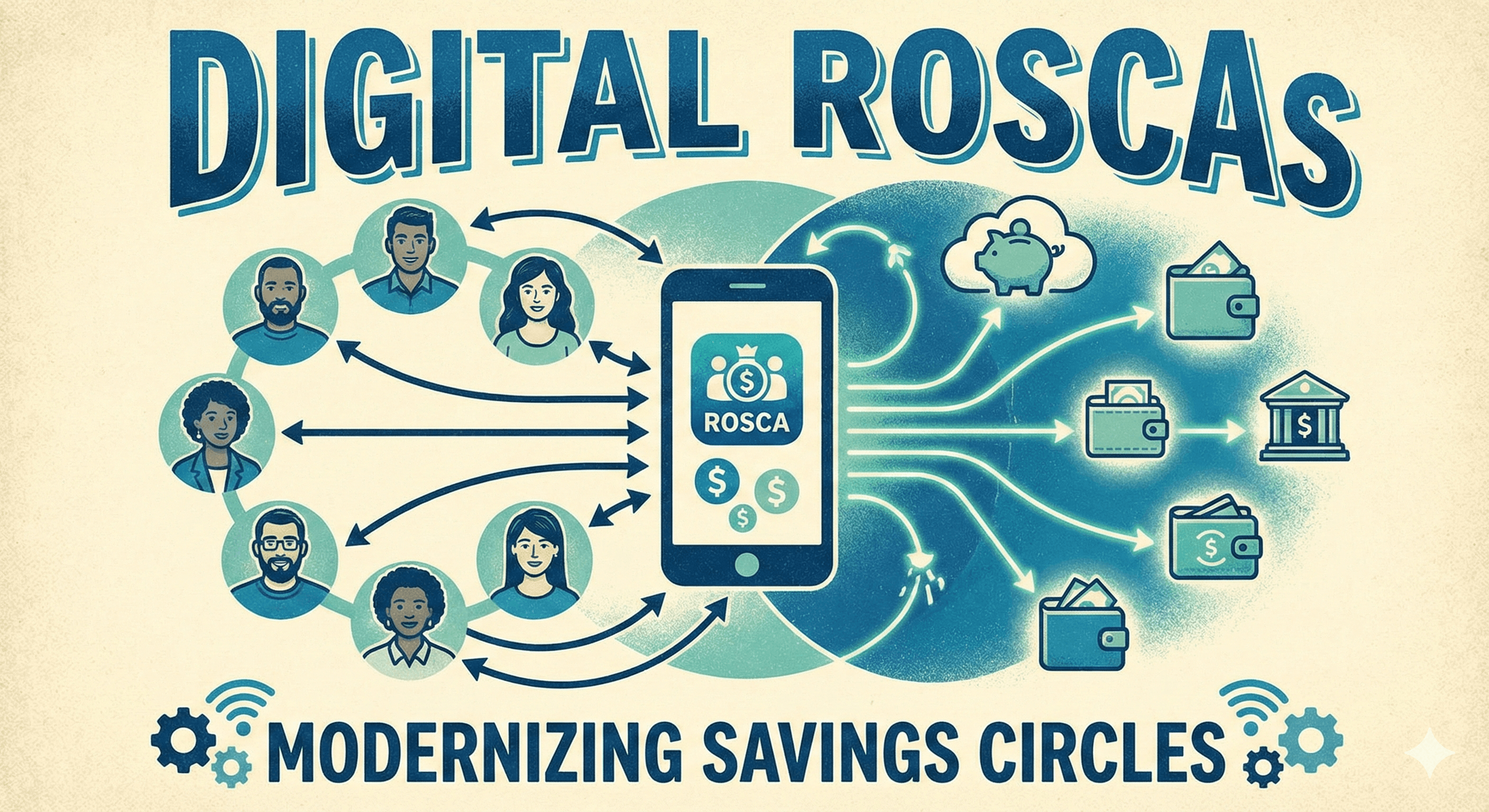
Traditional ROSCAs depend on physical meetups, cash collection, and a single organizer keeping track of everything in a notebook. That worked for centuries — but it creates friction, limits who can participate, and leaves no paper trail.
Duti digitizes the ROSCA without changing what makes it work. Here's what changes and what stays the same:
| Traditional ROSCA | Duti Online DuKuti | |
|---|---|---|
| Contributions | Cash at meetings | Bank transfers, automatic |
| Record keeping | Notebook / informal | Digital dashboard with full history |
| Payment reminders | Phone calls / word of mouth | Automatic notifications |
| Geographic limits | Same neighborhood/city | Anywhere in the US |
| Trust model | Community reputation | Community reputation + payment tracking |
| Tax treatment | Gift (not taxable) | Gift (not taxable) — learn why |
Ready to Start Your Circle?
Frequently Asked Questions
Is a ROSCA the same as a pyramid scheme?
No — and this is a common misconception. In a pyramid scheme, early members profit at the expense of later members, and the system eventually collapses. In a ROSCA, every member contributes the same total amount and receives the same total amount. There is no profit, no recruitment incentive, and no collapse. It's a zero-sum savings tool, not an investment or scheme.
Are ROSCA payouts taxable?
In the United States, ROSCA contributions are classified as gifts under IRS rules. As long as no single person gives more than $19,000 to another person in a year (the 2025 annual gift exclusion), no taxes are owed and no reporting is required. For a detailed breakdown, read our guide: Why Your Duti DuKuti Is Tax-Free.
How many people do I need to start a ROSCA?
You can start with as few as 3–5 people. Smaller groups are easier to manage and build trust faster. As you gain experience, you can grow to larger circles of 10, 20, or even 100 members. On Duti, circles range from small family groups to large community circles.
What happens if someone can't pay?
This depends on the group's rules. In traditional ROSCAs, social pressure and community reputation motivate payment. Some groups require a guarantor. On digital platforms like Duti, payment tracking and automated reminders help prevent missed payments. The best protection is always careful member selection — only invite people you trust.
Can I be in more than one ROSCA at a time?
Yes, many people participate in multiple ROSCAs simultaneously — sometimes with different contribution amounts or different groups of people. Just make sure you can comfortably afford all your commitments. Overextending yourself defeats the purpose of disciplined saving.
Is my money safe in a ROSCA?
ROSCAs are not FDIC insured like bank accounts. Your money's safety depends on the trustworthiness of the group members. This is why member selection is the most important step. Using a digital platform like Duti adds transparency through payment records and automated tracking, but the foundation is always trust between members.
How is a ROSCA different from a lending circle?
A lending circle (like those offered by Mission Asset Fund) often reports to credit bureaus and is structured as a loan. A ROSCA is structured as gifts between members — no loans, no interest, no credit reporting. Both involve group contributions, but they have different legal structures and purposes. Some people use ROSCAs for saving and lending circles for building credit.
How to Start or Join a ROSCA
1 Find Your People
2 Set the Terms
3 Choose Your Platform
4 Start Small, Build Trust
The Bottom Line
A ROSCA is community finance in its purest form: people helping people save, without banks, without interest, without barriers. It's worked for centuries across every continent, and it works today — whether you call it DuKuti, tanda, susu, or any of the dozens of other names this tradition carries around the world.
The only thing that's changed is convenience. Platforms like Duti make it possible to run a ROSCA entirely online — automatic payments, transparent records, no cash to collect — while preserving the trust and community connection that make the system work.
Your community already knows how to do this.
Related Reading
Explore more articles that complement this topic:
- Introduction to ROSCA: Community Savings Groups — A lighter introduction to ROSCAs with Tsewang's real-world story.
- Dhukuti in Nepal: How Traditional Savings Circles Build Community Wealth — Deep dive into Nepal's centuries-old savings tradition.
- The Digital Evolution of Community Savings — How technology is transforming traditional savings circles.
- Why Your Duti DuKuti Is Tax-Free — Complete guide to why ROSCA payouts aren't taxable income.
- Smart Financial Habits for Immigrants — Combine traditional savings wisdom with modern financial strategies.